
10A vs 16A electrical outlet: real differences and choice by environment
Home » Electricity » Installations and Components Electrical Installation » Switchboards and Distribution (Components)
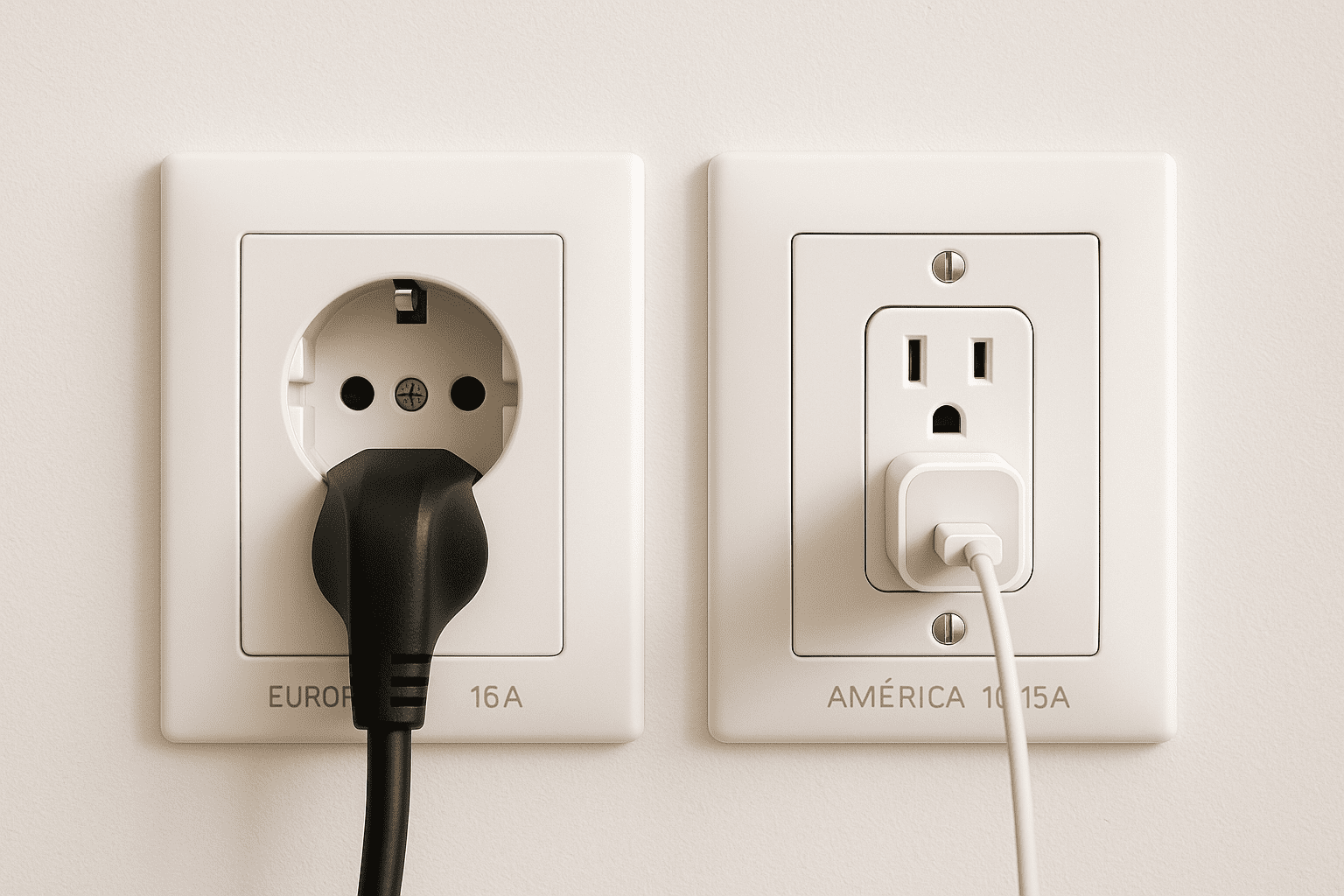

- Tamper Resistant: Child proof shutter mechanism inside the receptacle prevents young children from inserting unwanted ob…
- Self-Grounding: A green grounding screw and self-grounding clip provide for automatic grounding in the junction box, pro…
- Easy Installation: Designed for quick push-in wire and side wire. Break-off plaster ears for best flush alignment. Break…
How to read the current label and choose correctly
I'm Stevenson , an electrician with over 10 years of experience (former foreman of a 10-person team , Salesian Don Bosco training ). In this guide, I'll show you, in a practical way, how to interpret 10A and 16A electrical outlets in your home so you can choose the correct outlet for each room and type of appliance.
What do 10 A and 16 A mean at home (nominal current and power in watts)?
- Amperage (A): is the peak current that the outlet is designed to safely withstand.
- Estimated power (W)It depends on the tension of the system. For simple reference:
- A 230 V → 10 A ≈ 2.300 W | 16 A ≈ 3.680 W
- A 120 V → 10 A ≈ 1.200 W | 16 A ≈ 1.920 W
- Practical translation:
- 10 A is oriented to moderate loads (lamps, notebook, TV, small electronics).
- 16 A offers top margin for teams of high demand (certain small, powerful appliances, plug-in washer/mini dryer, some plug-in air conditioners), always with land and firm connections.
Quick tips for deciding
- Check the plate/label of the team: if it indicates 16 A or continuous high power, install Take 16A.
- Avoid “cascade adapters"or power strips to compensate for an insufficient base: they can heat and to falsify the land.
- if the team demands land (metal chassis), uses socket with effective groundIn environments with the Type F standard, this guide will be useful:
→ Schuko plug: what it is and when to use it at home. - Questions about country-specific formats and general compatibility?
→ Types of plugs and sockets in Hispanic countries (quick guide).
Real differences: contacts, grounding, and plug compatibility
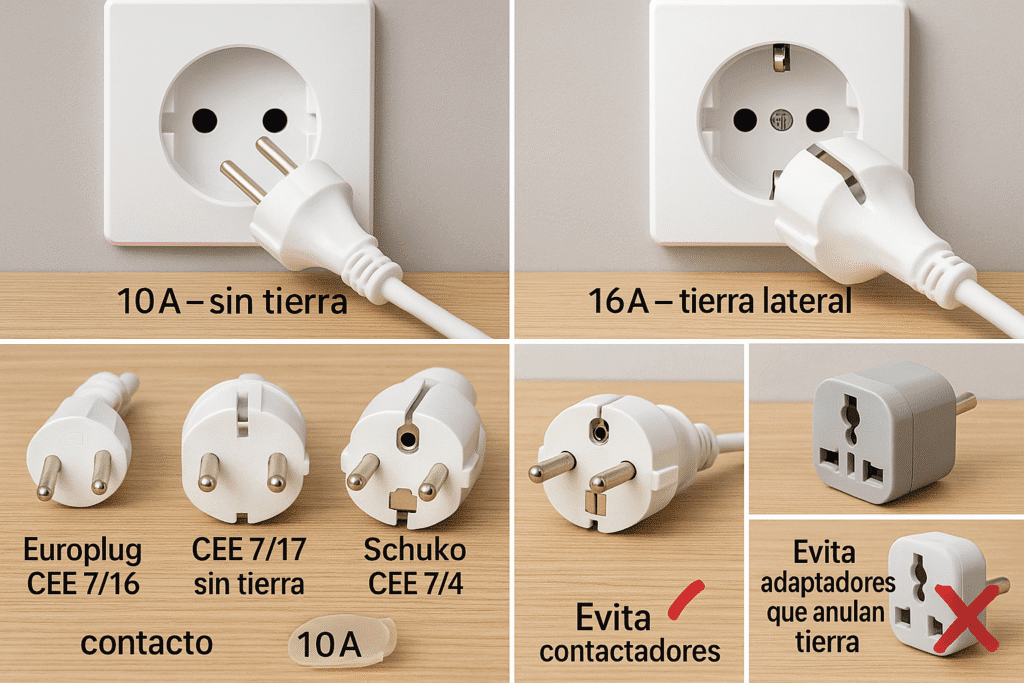
10 A: for moderate loads and when it falls short
- Contacts and sectionThe pins and springs of the base are usually Smaller; with equal consumption, they tend to warm up before than a 16 A if the connection is not perfect.
- Earth: in many formats from 10 to grounding is not present or it's implemented differently; beware of equipment from metal chassis.
- typical useLamps, TVs, chargers, audio equipment, small appliances low to medium power.
- When it falls short: powerful kettles, plug-in microwave, tools, washer/mini dryer… if the equipment plate brand more current/power of which the 10 A base supports.
16 A: larger contact surface, spring pressure and reliable grounding
- Contacts and pressure: terminals and springs of larger size and strength, which improves the tighten and reduces false contacts at high loads.
- Earth: in formats such as Schuko (Type F)The land is secured by side clips that embrace the shirt of the peg, giving continuity before energizing.
- typical usesmall electrical appliances powerful gifts, plug-in compact microwave/oven, washing machine, some units of AC plug-insworkshop tools.
- Practical advantage: better tolerance to peaks y continuous use within the nominal limit, always with wiring and protections chords.
Schuko format (Type F) and plug options (CEE 7/4 and 7/7)
- Schuko (Type F): base with lateral land by clips; recommended when the equipment requires land and demand 16 A.
- EEC 7/4 plug (Schuko “pure”): two pins + metal shirt that makes contact with the ground clips on the base.
- EEC 7/7 plug (hybrid E/F)It works on both outlets Type E (ground for pin) as in Type F (ground by clips). Useful if both standards coexist.
- CouncilIf the equipment requires grounding, avoid adapters that don't guarantee it; prioritizes the correct partner base-peg.
Expand details and use cases: Schuko plug: what it is and when to use it at home.
Solid mounting (series, racks and plates): Bases, frames and plates: compatibilities between brands and measurements.
Choice by environment (what to put in each area)
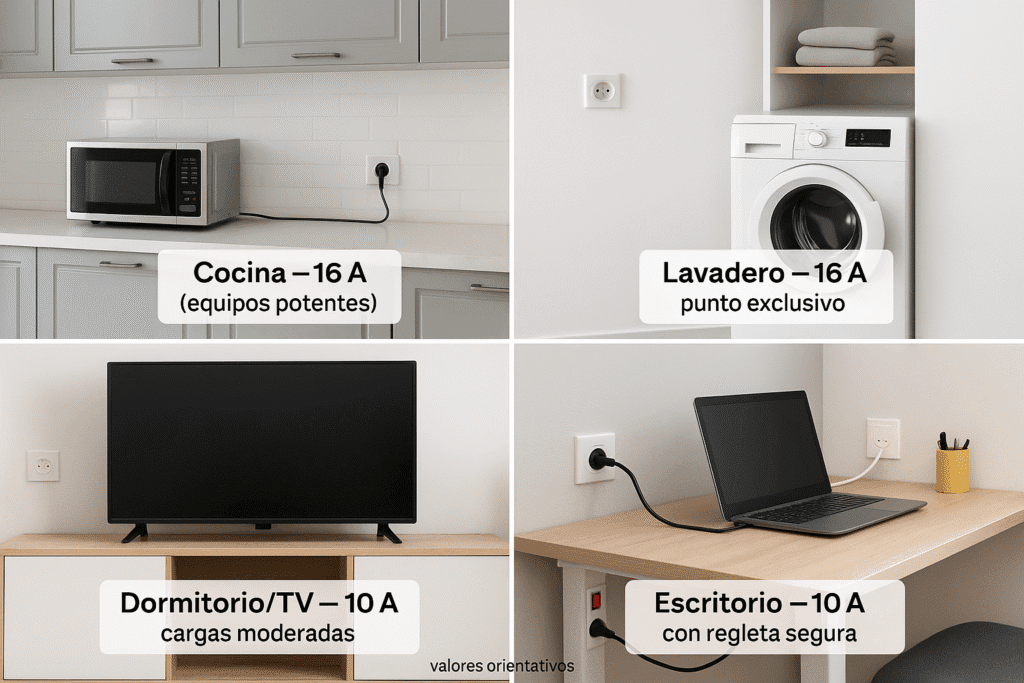
Kitchen: countertop, plug-in microwave/oven and small appliances
- Countertop (small appliances): if the equipment indicates ≤10A (e.g., compact toaster), one socket 10 A That's enough; if you specify 16 A or continuous high power (powerful kettle, large air fryer, robust mixer), install Take 16A with land and good timing.
- Plug-in compact microwave/oven: often 16 ACheck the equipment's nameplate; avoid power strips/adapters.
- Built-in oven/hob: they usually go wired to a dedicated circuit (not a power outlet).
- Helpful support:
→ Distribution and quantity by work area.
→ Why No. use power strips with kettle/microwave/oven.
→ Combination hobs USB + Schuko (for light loads and order).
Laundry room: plug-in washer and dryer (exclusive point)
- Washing machine: normally 16 A with exclusive shot and accessible (no power strips).
- Plug-in dryer: high demand and long cycles; it usually requires 16 A and in many cases dedicated circuit.
- Cable routing and ventilation: without mechanical stress or pressure against the furniture; leave space to dissipate heat from the plug.
- Support for: guide of plug, amperage and convenient location.
Bedroom/TV and desk: when 10A is enough and when to go up to 16A
- Bedroom/TV (typical consumption): TV, set-top box, game console and lights usually go well in 10 A if the base is firm and without cascading adapters.
- High-demand spot loads (heaters, stoves, powerful dryers): check the plateif they demand 16 A or they greatly increase the power, use Take 16A exclusive and avoid power strips.
- Order in TV zone: Remove dangling cables; if the furniture is flush, use low-profile outlets y angled pegs.
→ Low-profile solution for TV/furniture.
→ Risks and best practices in furniture/baseboards. - Desk: PC/monitor/chargers are usually 10 A; set one up power strip with switch and protection, screwed to the furniture, with good ventilation and without adapter "towers".
→ What should a good power strip have?
→ Order and ventilation under the desk.
→ USB/Schuko on the same board (order and fewer bulky chargers).
Proper assembly: case, motherboard and base quality

Built-in vs surface-mounted: when each is appropriate
- smothered
- When to use it: walls with 2x4 or 4x4 box and enough space to accommodate conductors without straining them. Ideal in bedrooms, living room and kitchen for aesthetic and safety reasons.
- Advantages: BEST mechanical protection, boards aligned with other modules (USB/TV/data), lower risk of impacts.
- Care: choose deep box if you use bulky connectors or if the installation has multiple splices.
- Expand: Recessed vs surface-mounted sockets: which to choose and why.
- Overlay
- When to use it: reforms without work, walls that are difficult to channel (cellar, garage, workshop) or when you need a point fast and accessible.
- Advantages: installation agile, simple maintenance, visible surface piping (easy to inspect).
- Care: Secure the box well, use a channel with end caps and protects from dust/impacts if there is traffic.
Terminal block, spacing and plug seat checklist (avoids overheating)
- Power outage and verification of absence of tension before work.
- Driver introduction: clean stripped (without cutting wires), bright copper, without rust or paint.
- Firmly borne: press the recommended paira loose screw = false contact y heating.
- Chord section: compatible driver and base nominal current (10 A or 16 A) of the point.
- Box space: No flattened joints; if there's a lack of volume, deeper box.
- Frame and plate from the same series: you avoid clearances and ensures a solid closure (no play).
- Peg seat: Try it with the actual equipment; it should work. firm and without sparks.
- Cable route: without mechanical stress (so the furniture doesn't "pull" on the plug), without sharp bends, and away from sources of heat/humidity.
- Final revision: Temperature check after 5–10 minutes of use with a load; if it heats up, de-energize and check the terminals.
Supports for solid and surprise-free mounting:
- Bases, frames and plates: Compatibility between brands and measurements.
- Recessed vs surface-mounted sockets: which to choose and why.
Special cases and common questions
Outdoors/terrace: use watertight containers (not open bases)
In patios or areas exposed to dust/water, avoid open sockets (10 A or 16 A). Install watertight sockets with covers, in a protected location and at a height that prevents puddles.
Power strips and adapters: false shortcuts
- 10A power strips with 16A equipment: can get warm and fire protections. Use exclusive spot 16 If the team requires it.
- “Multi-format” adapters: usually to annul the land or leave loose contactAvoid them in devices that require grounding.
→ Good practices and limits.
→ Difference between adapter y ecosystem (voltage).
What happens if there are 120V in my area?
Power depends on P = V×I: at 120 V, a point 10 A ≈ 1.200 W y 16 A ≈ 1.920 W (These are indicative values). Check local standard and plug format before choosing.
→ Formats by country (quick guide).
“My base is getting hot”: typical causes
- Loose terminal or a poorly presented driver.
- Power strip/adapters in cascade raising the current.
- 10A Base with equipment that demands more.
- Furniture/baseboard that presses on cables or prevents dissipation.
→ Risks and best practices in furniture/baseboards.
→ Built-in vs surface-mounted (when is each one appropriate).
“Can I just replace the cover with a 16A one?”
No. The cover/plate It's for aesthetics. You need to install one. base 16 A compatible with your frame/plate and with appropriate wiring.
→Ccompatibilities of bases, frames and plates.
"Can I use 10 A for a device that requires 16 A if I use it infrequently?"
It's not recommended: even if it's "a little," you run the risk of heating y land loss If you use adapters, install Take 16A or the solution indicated by the manufacturer.
→ When is it convenient Schuko (Type F) 16 A.

I'm Stevenson, better known as Steve the Poet . I'm a poet and writer, and I own a digital marketing agency , bignegro.com . I'm also an electrician with over 10 years of experience. I studied electricity at Salesianos Don Bosco and worked my way up from assistant to foreman of a 10-person crew. Today, I lead a small business.