
Dehumidifier vs humidifier: consumption and cost per room
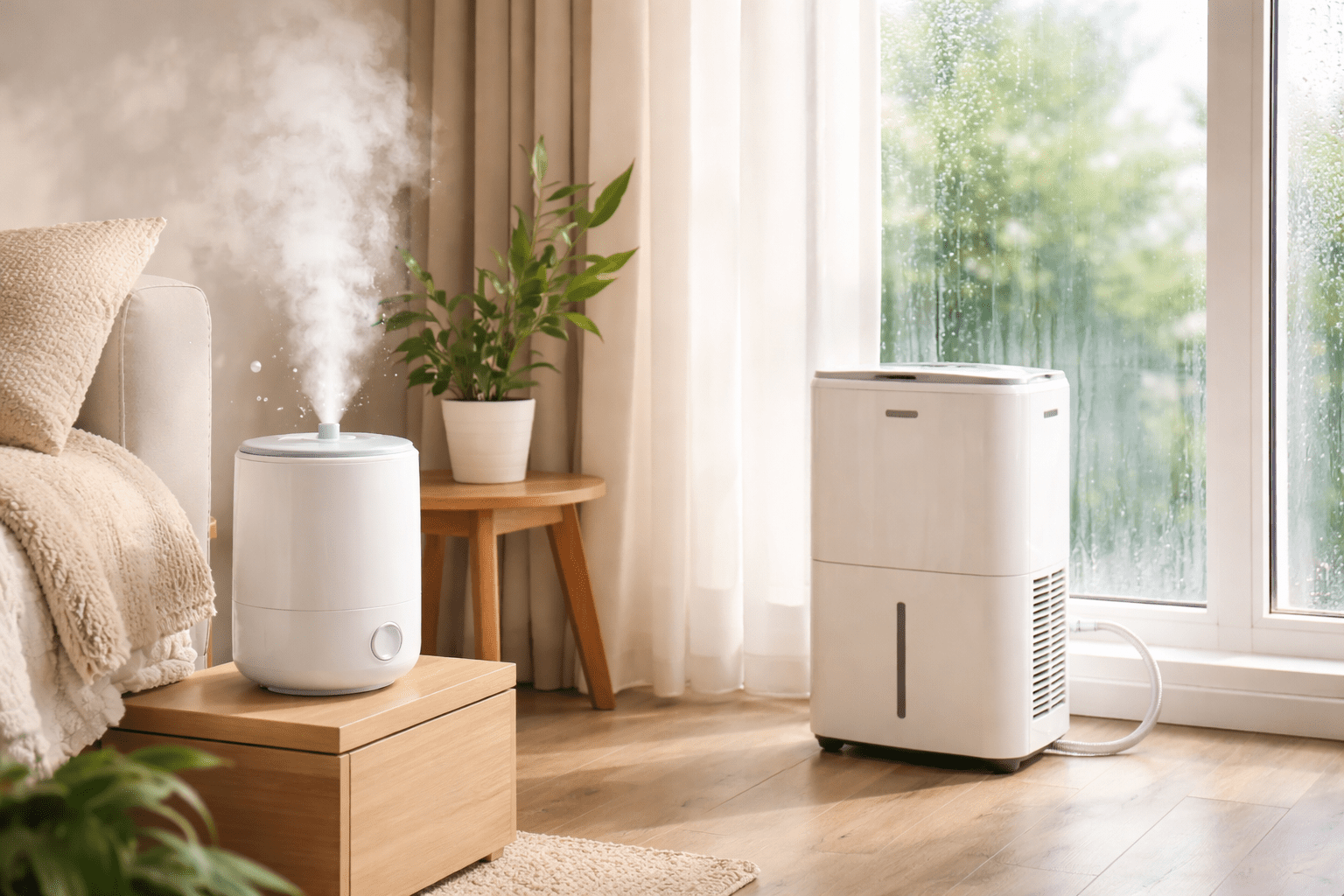
Quick calculator: What suits my room?
I want you to start with the answer, straight to the point. Choose your scenario, enter the square meters , hours of use , and $/kWh , and you'll see the daily and monthly costs immediately. (Healthy target: 40–60% RH ; aim for 35–45% in winter ).
Choose your case
- Dry air → Humidify (typical consumption: 20–60W).
- Humidity/mold → Dehumidify (typical consumption: 250–700W).
Calculator (simple and already visible)
If you're unsure about the power output, use the presets and adjust accordingly. The results are for reference only.
Direct result
- $ per day y $ per month They are updated when they change hours, $/kWh o power.
- If you don't know the power, start with a preset and adjust it according to your equipment.
Tip (based on experience): Before buying, measure humidity with a hygrometer for 24–48 hours. If it's below 35% , you should humidify ; if it 's above 60% , dehumidify . Adjust the humidity level gradually (in 5% increments) to avoid overspending.
Decision cards: quick signals
Symptoms of dry air → Humidify
- Dry nose and throatcough upon waking, chapped lips.
- Tight skin and irritated eyes (especially with the heating on).
- Plants with brown tips or curly leaves.
- Static electricity when touching clothes or furniture.
What do I do? I aim to 35–45% RH In winter, I put the humidifier on. high (table/shelf), with fog outlet spirit and away from walls and bedding to avoid localized dampness.
Useful shortcuts
- Standard bedroom: part with car mode and the target goes up/down in 5% increments until you feel comfortable.
- Easy maintenance: top filling y weekly cleaning (avoid odors and "white powder"). If you use tap water, consider filter.
Symptoms of dampness/mold → Dehumidify
- Mold stains in corners or behind furniture.
- Windows with condensation and a musty smell.
- Clothes that It takes a long time to dry indoors.
- Sensation of heaviness in the environment (basements/ground floors).
What do I do? I search 45–50% RH sustained notes and, if possible, use continuous drainage to avoid emptying the bucket. I raise the unit a few centimeters to improve the water flow.
Useful shortcuts
- Start of treatment: the team will work during the first 48–72 hours more hoursThen, as it stabilizes, the time decreases.
- Maintenance: clean filter and check that the hose has a drop (without siphons). If you see Frost Punctual, it's normal in some cycles.
Tip in 10 seconds (my way of deciding):
- put a hygrometer 24–48 h.
- yes mark <35%It humidifies. If >60%, dehumidifies.
- Adjust your goal gradually (± 5%) until you are comfortable without overspending.
Room size: how to size (m² → suggested L/day / W)
If the air is DRY → Humidifier (W is approximate)
| Size | Suggested power | Hours/day | Humidity target |
|---|---|---|---|
| 10-12m² | 20–30W | 6–8 hours | 35–45% RH |
| 15-18m² | 30–40W | 6–8 hours | 40–50% RH |
| 20-25m² | 40–60W | 6–10 hours | 40–50% RH |

- 𝙀𝙛𝙛𝙤𝙧𝙩𝙡𝙚𝙨𝙨 𝘿𝙧𝙮 𝘼𝙞𝙧: Designed for ultimate comfort, this humidifier effectively covers rooms up to 505 ft² wi…
- The built-in sensor prevents over-humidification by monitoring room moisture and adjusting…
- 𝘼𝙡𝙡-𝙞𝙣-𝙊𝙣𝙚 𝘼𝙥𝙥 & 𝙑𝙤𝙞𝙘𝙚 𝘾𝙤𝙣𝙩𝙧𝙤𝙡: Use the VeSync app from anywhere to adjust mist output, set timers, and monitor humidity…
If the air is HUMID → Dehumidifier (L/day guideline)
| Size | Suggested capacity | Hours/day (start → maintenance) | Humidity target |
|---|---|---|---|
| 10-12m² | 10–12 L/day | 3–5 h → 2–3 h | 45–50% RH |
| 15-18m² | 12–20 L/day | 4–6 h → 2–4 h | 45–50% RH |
| 20-25m² | 20–30 L/day | 6–8 h → 3–5 h | 45–50% RH |
Fast notes
- Adjusts in 5% increments according to your hygrometer.
- Set up the equipment high and clear; in a dehumidifier, leave good ventilation and use continuous drainage if possible.
- Check out filters and cleaning weekly to maintain performance.
Typical consumption per device
Dehumidifier (≈250–700 W)
In humid environments, typical energy consumption ranges from 250 to 700 W , depending on the size (L/day) , mode , and initial humidity . It usually runs for longer hours initially; once the room stabilizes at 45–50% RH , the daily run time decreases. It's normal to feel heat from the top vent and hear a whirring sound . When possible, I prefer continuous drainage to avoid emptying the bucket.

- Easy-to-Clean Washable Filter: Capture dust from the air and keep your dehumidifier working efficiently with our easy-to…
- Custom Humidity Control: Maximize your customized comfort with control over the amount of humidity in your room
- Continuous Drain Option: Skip emptying the water bucket — this unit continuously drains your dehumidifier so that you…
Humidifier (≈20–60 W)
For dry air in bedrooms/offices, a domestic ultrasonic air purifier typically consumes 20–60 W. In winter, I aim for 35–45% RH for comfortable sleep and to prevent condensation on cold windows. Place it high up and in a clear area , use Auto mode , and perform weekly cleaning ; if using tap water, consider using a filter or distilled water to prevent white dust.
Factors that raise or lower consumption
- Humidity target: More demanding goals mean more hours at the beginning.
- Location and flow rate: Blocked outlets or close to the wall = less efficiency.
- Maintenance: Dirty filter, limescale or hose without drainage increase consumption.
- How to use: “Auto” properly set saves; “Continuous” only when needed.
Reasonable hours of use per season
Dry winter
- Objective: 35–45% RH in bedrooms and living rooms.
- Typical hours (humidifier): 6–8 hours at night; if the environment is very dry, add 1–2 hours in the afternoon.
- Quick Tips:
- Place it high and clear (table/shelf).
- Usa car mode and lower/raise the target in 5% increments until comfortable.
- If you see condensation in windows, reduce the target or pushes the fog away from walls and curtains.
Wet autumn
- Objective: 45–50% RH sustained to prevent mold.
- Typical hours (dehumidifier): 4–6 h/day at the beginning; when the site stabilizes, 2–4 h/day.
- Quick Tips:
- If you can, use continuous drainage so as not to empty the bucket.
- Elevate unity a few centimeters to improve the flow of water.
- Check out filter and that hose have a slope (without “siphons”).
Summer (coast vs inland)
- Coast: The ambient humidity rises; keep 45–50% RH with 3–5 h/day (dehumidifier), more if you cook or hang clothes inside.
- Dry interior: that may suffice humidifier 2–4 hours in the afternoon/evening if the air conditioning dries it out (objective 40–45% RH).
- Quick Tips:
- Ventilate briefly during cooler hours; then close and let the equipment work.
- In humid heat waves, the dehumidifier will emit heat: plan schedules (afternoon/evening).
Comparative calculator: kWh and cost per day
Inputs: m², current/target humidity, hours, $/kWh, equipment type
Fill in the fields and get suggested W , kWh/day , $/day and $/month . The values are for guidance only.
Outputs: Suggested W, kWh/day, $/day and $/month
- Suggested W They are calculated automatically according to m² y type (You can adjust it manually).
- kWh/day = (W/1000) × hours.
- $ It is calculated with your $/kWh and currency chosen.
Monthly preset ($/month with days/week × weeks/month)
- Adjust “Days per week"And"Weeks per month"to see a $ realistic monthly if you don't use it every day.
Note: distilled water vs tap water (ultrasonic and “white powder”)
- En ultrasonic humidifiers, tap water can leave white residue on surfaces.
- Recommended: distilled water o filter to avoid it and make cleaning easier.
Quick actions: copy results and save as image
- Copy results: takes the numbers to the clipboard for sharing.
- Save as image (PNG): generates a card with your data to save or send.
Quick comparison table: 3 sizes × 3 prices $/kWh
Express view in $/100 h to compare without formulas. Adjust prices if your bill is different (reference values).
Reference prices
Humidifier (low consumption)
| Power | $0.12/kWh | $0.20/kWh | $0.35/kWh |
|---|
Dehumidifier (average consumption)
| Power | $0.12/kWh | $0.20/kWh | $0.35/kWh |
|---|
How to read it quickly
- humidifier: low and stable numbers (20–60 W).
- Dehumidifier: varies more (300–600 W). If your price/kWh changes, edit it above and the table will recalculate automatically.
Real-life cases (practical application)
Bedroom 12 m² (dry)
In winter, when I find my mucous membranes dry and the hygrometer reads 30–35% RH, use humidifier de 30–40W en car mode with objective 40–45% RHI'll put it there. high and clear (shelf/table), I direct the fog outlet away from walls and bedding and make weekly cleaning. With 8 hours at nightComfort improves in 30–60 mins and no condensation appears on the window.
Typical settings: If I wake up to a humid window, I lower the lens by 5% or move the equipment a little further away.
Room 20 m² (humid)
When I arrive with 65–70% RH and damp stains, I propose dehumidifier de 20–30 L/day (≈450–600W). Starting with a goal 50% HR during 4–6 h/day the first 48–72 h; upon stabilization, lower to 45% HR and I remain in 2–3 h/day. Prefer continuous drainage (hose with drop) and I raise the unit a few centimeters to improve drainage.
Typical settings: If the bucket fills up too quickly, I switch to drain; if the equipment doesn't shut off when it reaches the target percentage, I check. filter y air flow.
Savings without sacrificing comfort
Equipment location and height
- High and clear: on a table/shelf, with free access. Avoid enclosed corners and tightly pressed curtains.
- Distance50–80 cm from walls and furniture to allow air to circulate.
- Doors/windows: ventilate briefly (5–10 min) and then cierra so that the team works less.
Auto mode and timers; external hygrometer
- Well-tuned car Save more than "Continuous". Raise/lower the target in 5% increments.
- Timer: nights (humidifier) or evenings/early evening (dehumidifier if it emits heat).
- External hygrometer: checks the actual % and corrects if the equipment reading deviates.
Tricks I cut out at home
- humidifier: uses top filling y weekly cleaningWith tap water, add filter or alternates with distilled to avoid “white dust”.
- Dehumidifier: yes you can, continuous drainageRaise the unit a few centimeters and check the hose slope.
- Realistic goals: Winter 35–45% RH (Prevents condensation). High humidity 45–50% RH sustained.
Safety and basic maintenance (see local regulations)
Humidifier: weekly cleaning; distilled water/filter
- Unplug before cleaning.
- Weekly cleaning (5–10 min): Empty the tank, rinse with warm water, and wipe the base and nozzle with a soft cloth. If there is limescale, use a mild mixture of water and vinegar, rinse well, and let it dry.
- Water: In ultrasonics, he prefers distilled water o filters to avoid “white powder” on surfaces.
- Safe location: High and clear, without drips near sockets or textiles.
- Humidity target: winter 35–45% RH; rest of the year 40–50% RH to prevent condensation and mold.
- Warning: if you notice escapes, strong smell o abnormal noisesTurn it off and unplug it. Do not tamper with internal components if you are not experienced; consult technical support (see local regulations).
Dehumidifier: washable filter; drop-off hose; occasional frost
- Unplug before cleaning or moving.
- Filter: rinse the washable filter every 2–4 weeks depending on powder/use.
- Sewer system: if you use hoseMake sure it has constant slope (without “siphons”). Raise the unit a few centimeters to improve the drop.
- Ventilation: Leave free space around it so it can breathe; don't put it right up against the wall.
- Spot frost: It can appear in cold environments; many units do de-icing cyclesIf ice persists, turn off, let it defrost, and check the filter/airflow.
- Warning: Yes there are error codes, electrical smells, sparks o excessive heatTurn it off and consult an authorized technician (see local regulations).
What to expect at 12–24 months: typical faults and extended warranty
- Dehumidifiers: Some users report system sealing/code failures (EC/F0) around the 12–24 monthsIf your usage is intensive (damp basement, coastal area), value extended warranty.
- Humidifiers: can appear tank leaks or failures after power outages in certain models; the brand support usually answers.
- My recomendation: look at the ticket, registers the equipment in the app/manufacturer's website and performs periodic cleaningIt greatly reduces problems.
Downloadable checklist (fast)
Humidifier (weekly)
- Unplugged and tank empty
- Clean base/nozzle and rinse
- Check filters/pads
- High and unobstructed location
- Target between 35–50% RH depending on the season
Dehumidifier (bi-weekly)
- Unplugged
- Washed and dried filter
- Hose with a drop and without obstructions
- Separation of walls/obstacles
- Target 45–50% sustained RH
General safety: disconnect the power before handling, do not tamper with the equipment if you lack knowledge, and if in doubt contact an authorized technician (see local regulations).
Quick solution to common problems
EC/F0 (dehumidifier)
- What is it: common error codes (sealed/freezed system).
- What I do:
- Turn off and unplug 10–15 min.
- Exfoliate your skin filter and check ventilation around.
- If you use hose, check that there is no siphon nor obstructions.
- In very cold environments, it leaves defrost and try it in mode Cars.
- If the code returns: contact us technical service; values Warranty if it is in effect.
Freezing (ice rolls, dehumidifier)
- Typical causes: Cold environment, dirty filter, poor airflow.
- Quick solution: Turn it off, leave it defrost, wash the filter, separate the equipment from walls (50–80 cm), return in Cars Target 45–50% RH. If it persists, contact technical service.
It doesn't cut off when it reaches the target percentage.
- Review: location (corners are deceiving), external hygrometer (compare reading), filter cleansed.
- Settings: lower the target 5% Or reposition the unit so it can better "read" the environment. For dehumidifiers, confirm. sewer system and good airflow.
“White powder” (ultrasonic humidifier)
- What is it: minerals of tap water that are deposited.
- Solution: uses distilled water o filterClean the tank/nozzle once a week. Reduce power if you see moisture on nearby surfaces.
Leaking tank (humidifier) or splashing bucket (dehumidifier)
- Humidifier: check gaskets/caps, do not exceed the maximum line, place the tank well settledIf this continues, stop using it and contact support.
- Dehumidifier: Empty the bucket carefully (it may splash). If using a hose, raise the equipment. a few centimeters and confirm constant slope towards the drain.
App not syncing / erratic readings
- Quick Steps: Restart app/device, update firmwarereconnects to Wi-Fi (Guest network recommended for IoT).
- Strange readings: contrasts with external hygrometer; adjust the humidity target in the app (winter: 35-45%; wet: 45-50%).
- If the problem persists after restarting, contact the manufacturer's support.
FAQs + mini glossary
In general, a dehumidifier (approximately 250–700 W) uses more energy than a humidifier (approximately 20–60 W). If the room is very humid to begin with, the dehumidifier will run for longer hours the first few days and then reduce its operating time once the relative humidity stabilizes at 45–50% . I start with a high setting, let it stabilize, and then reduce the operating hours.
Humidifier (dry): 6–8 hours at night is usually enough in the bedroom.
Dehumidifier (humid): 4–6 h/day initially; then 2–4 h/day to maintain.
Adjust with a hygrometer and move the goal ± 5% according to comfort.
This is normal in ultrasonic cleaners if you use tap water : minerals deposit on surfaces. Solutions: distilled or filtered water , weekly cleaning, and moderate power to avoid excessive mist.
These usually indicate a failure in the sealing system or freezing of the coils. My quick routine: turn off and unplug, clean the filter , ventilate the unit, check the hose , and restart in Auto mode . If the problem persists, contact a technician (see local regulations).
To prevent condensation on cold windows, maintain 35–45% RH in bedrooms. If you see condensation, lower the humidity by 5% , relocate the unit further from walls, or reduce its power.
Mini glossary
L/day (liters per day): Dehumidifier extraction capacity. More L/day = faster humidity reduction.
Hygrometer: Relative humidity meter %RHUse it to decide whether to humidify or dehumidify.
Humidistat: Control that sets the %RH target in the equipment (similar to a thermostat, but for humidity).
Ultrasonic / Evaporative: Types of humidifiers. The ultrasonic It is quiet and efficient, but with a tap it can leave "white powder". evaporative Use a wick/fan and it usually avoids those residues.
Condensation: Water appearing on windows/cold surfaces when humidity is high. A sign that you should lower the target %RH or improve ventilation.
Your plan in 30 seconds
3 steps: measure → choose preset → adjust target
- It measures 24–48 h with a hygrometer.
- Si <35% RH: air dry → humidify.
- Si >60% RH: air damp → dehumidify.
- Choose a preset according to your room size (m²) and apply it in the calculator.
- Bedroom 10–12 m² dry → 20–30W.
- 20 m² wet room → 20–30 L/day (≈ 450–600W).
- Adjust the goal from humidity until comfortable without overspending.
- Winter: 35–45% RH.
- Damp/moldy: 45–50% RH sustained.
Buttons: “Dry (40–45%)” / “Humid (45–50%)”
- Dry (40–45%)Place the humidifier high and clearmode Cars, cleaning weekly And if you use tap water, filter o distilled to avoid “white dust”.
- Humid (45–50%): dehumidifier with continuous drainage if possible, clean filterspace for ventilation and hose with drop.
If you want to see another clear example of how I go from energy (kWh) to cost ($) at home, check out this practical case: Electric bicycles and scooters: kWh per charge and real cost.

I'm Stevenson, better known as Steve the Poet . I'm a poet and writer, and I own a digital marketing agency , bignegro.com . I'm also an electrician with over 10 years of experience. I studied electricity at Salesianos Don Bosco and worked my way up from assistant to foreman of a 10-person crew. Today, I lead a small business.