
Water pump and pressure booster: consumption and cost in multi-story homes
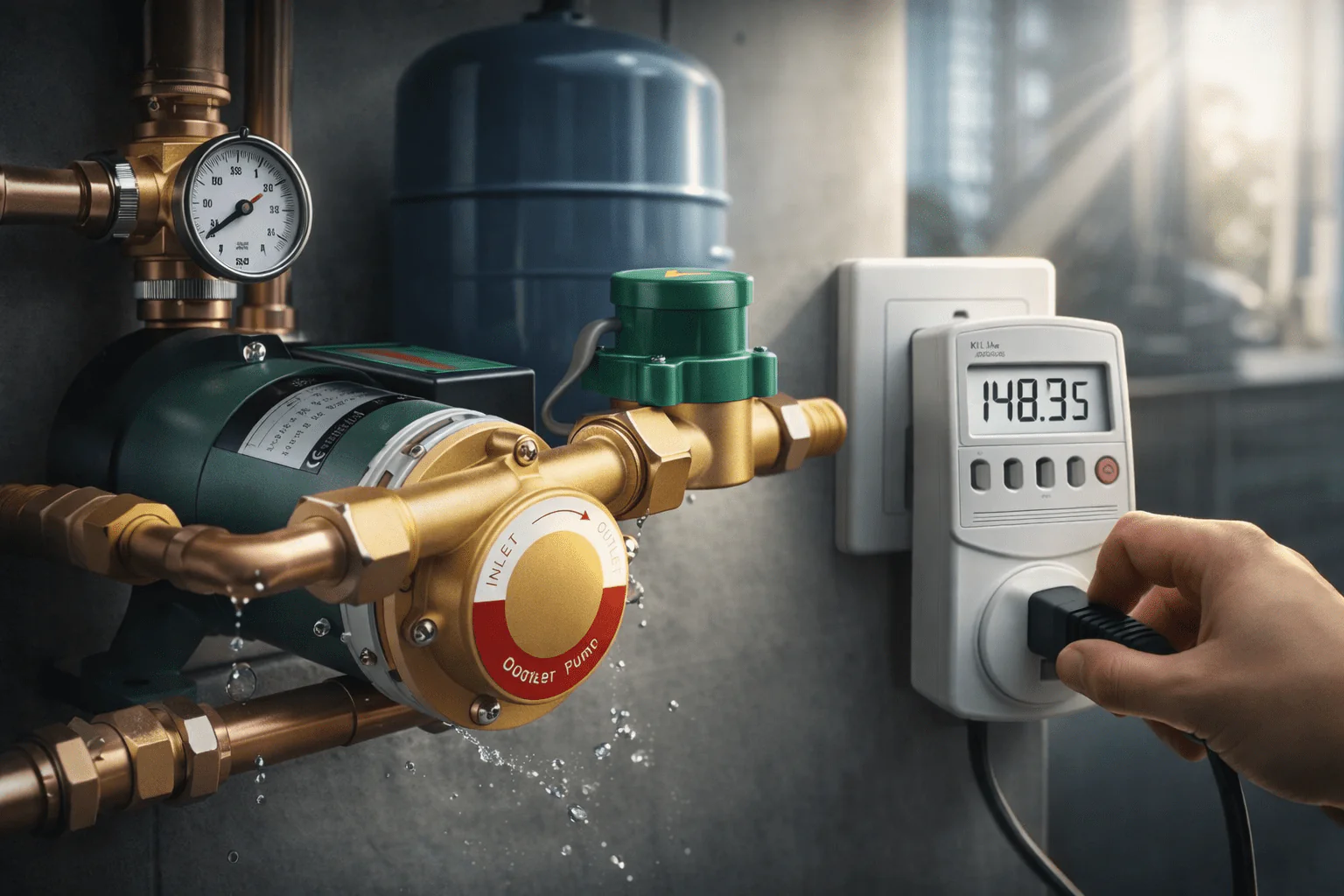
I'm Stevenson Jacques. In dozens of one-, two-, and three-story houses, I've seen the same thing: good water pressure in the morning, a drop when two people shower, and a bill that goes up "without explanation." In this article, I'll show you, simply, how much a pump or pressure booster can cost based on your usage and how often it starts per day , and how to lower that consumption without sacrificing comfort. The key idea is clear: you don't pay for the power alone, you pay for the amount of time the pump is running.
Clear summary: How much can they spend on your house?
From my experience installing and adjusting equipment in 1, 2 and 3 floor houses, what weighs most heavily on the bill is not only the power of the equipment, but how many minutes it pumps per day and how many times it starts.
- Indicative ranges (household):
- Pressure boosters: ~90–150 W (continuous or on demand).
- Pumps: 0,5–1 HP (≈370–750 W) depending on height, flow rate and layout.
- Main ideaIf your 750W pump only works 15 min/day, it will use less energy than a 120W pressure booster that stays on for 90 min/day due to micro-leaks or poor settings.
- Quick rule (to compare you):
kWh/month ≈ (W/1000) × (min/day ÷ 60) × 30
(Then multiply by the price of your kWh to see $/month.)
Quick reference (minutes of pumping make a difference)
These numbers are approximate and used to visualize orders of magnitude. Adjust with your actual minutes.
120W Pressure Booster
If it gets "stuck" due to micro-leaks, the minutes increase and so does the cost.
0,75 HP pump (≈560 W)
On high/long routes or routes with bends, it may require more time.
1 HP pump (≈750 W)
If the pumping time decreases (better layout/adjustments), the kWh drops sharply.
Lightweight Boost 100W
Ideal if the problem is only "raising" pressure at specific points.
How I apply it in the field: when people call me "because the pump is using a lot of water," I first measure actual minutes (using a stopwatch on my cell phone, for two days) and count the number of starts . If I see more than 20-30 short starts/day in a normal house, I know there's hidden consumption due to unnecessary cycles (micro-leaks, a poorly calibrated pressure switch, or no expansion tank).
Basic concepts to avoid getting lost
Pump vs. pressure booster: what each one does
- Water pump (centrifugal/self-priming): It moves water from a pond/well or from the mains into your plumbing system, "pushing" it to upper floors. It typically works by ciclos (starts, increases pressure/flow rate, stops).
- Pressure booster: It does not "bring" water from a reservoir, but rather raises blood pressure Available in the existing plumbing so the shower doesn't run. Operates request (when you turn on a tap) and it stops when you turn it off.
- Where they are used: In 2-3 story houses with pressure drops, a pressure booster system addresses peak demand (shower/sink). If you supply the entire house from one pond, the bomb It is the main feature (and you can add an internal network pressure booster for fine comfort).
Manometric height, flow rate and simultaneity (two showers at the same time)
- Manometric height (m/ft): height difference that the pump must overcome + Friction losses in pipes, elbows, and valves. The greater the height/length and the more elbows, the greater the losses. more effort and pumping time.
- Flow rate (L/min or GPM): volume you want to deliver. One shower domestic workers usually ask ~7–12 L/minTwo showers at the same time may require >15 L/min.
- Simultaneity: Yes there are two lawsuits (showers + washing machine), you need stable pressure and sufficient flow; if the pump/pressure booster is too small, you lengthen the minutes of operation (and the kWh/month goes up).
- Practical rule: size for the worst peak A realistic setup (e.g., two showers + sink) prevents the team from working under excessive pressure and having to pump longer.
Pressure switch/flow sensor control vs. frequency inverter
- Pressure switch (pressure): It starts when the pressure drops below a certain threshold (e.g., 30 psi) and stops when it reaches another (e.g., 50 psi). It's simple and inexpensive, but it can generate short cycles if there are micro-leaks or a small expansion tank.
- Flow sensor: active upon detecting water passageUseful for compact pressure boosters; if there are leaks/air, it can turn on/off Following.
- Frequency converter (inverter): modulates the RPM all with maintain constant pressure with fewer start-up peaks. Improves comfort and reduces starts (and noise), although it costs more and requires good setup.
Quick tip (from my experience): When the problem is only high pressure during peak hours (morning showers), a pressure booster with a small expansion tank and proper adjustment is usually sufficient. If you're supplying water from a storage tank and have two or more floors , a well-sized pump plus a calibrated pressure switch (or a variable frequency drive if budget allows and there are multiple simultaneous demands) has given me the best balance between comfort and kWh/month.
Typical power ratings and factors influencing consumption
From what I see on the ground, most households fall within these ranges. Keep in mind: power (W/HP) only tells part of the story; the pumping time and how often the machine starts ultimately determine the bill.
Domestic guide ranges (W/HP)
- Compact pressure boosters: ~90–150 W.
- 0,5 HP Pumps: ≈ 370 W.
- 0,75 HP Pumps: ≈ 550–600 W.
- 1 HP Pumps: ≈ 730–800 W.
- With variable frequency drive (VFD): the power average It lowers the RPMs under soft demands because it modulates the RPMs.
Factors that raise/lower spending
- Height/travel: More vertical meters and more meters of piping ⇒ more work ⇒ more minutes per day.
- Diameter and elbows: Small pipes and many elbows lose pressure; the pump compensates with more time.
- Control type: pressure switch/flow sensor can generate short cycles (on/off) if there are micro-leaks; a VFD It maintains pressure with fewer peaks.
- System status: dirty filters, air, leaking check valve ⇒ the pump “sticks” and adds minutes.
- Simultaneity: Two showers and a washing machine running simultaneously increase the effective time pumping.
Why starts per day and duration matter
- StartsEach start introduces a current spike and wear; many short starts per day are an invisible "bleed".
- Duration: at equal power, double the minutes almost pumping doubles the kWh.
- How do I avoid it?: adjustment pressure switch (looser pressure bands), sumo expansion tank and I delete micro-leaks before thinking about changing teams.
Comparative table (minutes determine kWh)
| Type | Power (W) | Min/day | kWh/month (calculation) |
|---|---|---|---|
| Compact pressure booster | 120 | 25 | ≈ 1,50 0,120 × (25/60) × 30 |
| 0,5 HP Pump | 370 | 30 | ≈ 5,55 0,370 × (30/60) × 30 |
| 0,75 HP Pump | 560 | 40 | ≈ 11,20 0,560 × (40/60) × 30 |
| 1 HP Pump | 750 | 60 | ≈ 22,50 0,750 × (60/60) × 30 |
| System with VFD | 400 (average) | 50 | ≈ 10,00 0,400 × (50/60) × 30 |
| Pressure booster with micro-leak | 120 | 120 | ≈ 7,20 0,120 × (120/60) × 30 |
How I apply it: Before blaming the pump, I compare power output with minutes/day . If the kWh/month is high, I check for starts , leaks , and filters . In many homes, I've reduced consumption by 20–40% simply by increasing the volume of the expansion tank and calibrating the pressure switch to prevent short cycles.
Calculation method: from W/HP to kWh to $/month
Practical steps: W → kW → kWh/day → kWh/month → cost
- Identify the power of your computer (on the motherboard: W or HP).
- If it comes in HP, I convert to W:
0,5 HP ≈ 370 W,0,75 HP ≈ 560 W,1 HP ≈ 750 W(approximately domestic).
- If it comes in HP, I convert to W:
- Convert to kW: divide by 1.000.
- Ex .:
560 W = 0,560 kW.
- Ex .:
- Calculate kWh/day:
kW × (minutos de bombeo/60).- Ex .:
0,560 × (40/60) = 0,373 kWh/día.
- Ex .:
- Projected monthly:
kWh/día × 30.- Ex .:
0,373 × 30 = 11,19 kWh/mes.
- Ex .:
- Convert to local currency:
kWh/mes × precio kWh.- If you don't remember your rate or charges, here's a simple explanation of how to read your bill: Understand your kWh price on your bill.
- And if you want to do the calculation in one step, use my tool: Calculate your kWh in pesos.
From my experience, the most common mistake is underestimating the actual pumping time: in two-story houses with two showers, 30–60 min/day is normal if more than one person showers in the same time slot.
How to measure with a tap meter and for how long
When I have doubts (or there are micro-leaks), I measure the actual consumption with a plug-in meter.

- Choose from the Kill-a-Watt's four settings to monitor your electrical usage
- Monitor your electrical usage by day, week, month, or year
- Features an easy-to-read screen
- → Practical tool (only mention): P3 P4400 Kill A Watt
- I connect it between the device and the outlet, and leave 24–48 hours.
- Leo W (instant), kWh accumulated and, if I want, the power factor to understand if there are spikes at startup.
- Tip: if your installation is 220-240 V, use the compatible version from the manufacturer (This model is typical for 115V).
- What record: peak usage hours (showers), quantity of starts and if the pump gets "stuck" when it shouldn't (kWh increases without demand).
- What does the measurement tell me? if the kWh/day It is high in hours of non-use, there are escapes o aireIf it only rises in peaks, the problem is simultaneity o sizing.
Common mistake: measuring too little time or mixing equipment
- Very little time: 10–15 minutes does not reflect shower cycles, washing machine use, or toilet tank refills. I measure minimum 24 h (Ideally 48 hours with one workday and one weekend).
- Mix teams: Don't measure pump and other power consumption on the same power strip: isolate the pump/pressure booster so that the kWh is required of that load.
- Power outages: If there's a cut, I note the time to understand strange jumps in the series.
How to estimate your daily starts and operating minutes
The key here is to translate your water usage habits into actual pumping time . With that, the rest (kWh and $/month) will fall into place.
Shower, sink, toilet, washing machine/dishwasher: guide values
These are approximate ranges for a standard house. Adjust them to your specific situation.
- Shower
- Typical duration per person: 8–12 mins.
- If there are 3 people and two shower one after the other in the morning: 16–24 mins from almost continuous pumping.
- Efficient head helps to lower flow rate ⇒ fewer minutes to achieve comfort.
- Handwash
- Hand/face washing: 0,5–1 mins by event.
- Brushing your teeth (if you open/close properly): 1–2 mins of accumulated flow.
- WC (flush)
- Pond filling: 0,5–1,5 mins according to volume and pressure.
- Washing machine
- Water loads per cycle: 2–3 filling moments.
- Total fill time: 5–10 mins through washing.
- Dishwasher
- Short and repeated fillings: 5–8 mins per cycle.
- Fast watering (terrace/patio)
- Open hose: 5–15 mins according to routine.
How I add it up (rule of thumb):
- I note events of the day (showers, washing machine, toilet, etc.).
- I multiply by your minute guide.
- If there was simultaneity (shower + sink), I don't double up on minutesThe pump was already on. I'm only adding if there's extra flow. prolonged the total time.
Multi-story housing: simultaneous occupancy and peak demand
- Morning and night They concentrate the use: two showers + sink at the same time ⇒ the pump does not rest.
- Greater height = greater losses: similar custom, on 2-3 floors the pump usually to extend minutes to maintain pressure.
- Pressure booster vs. pump with tank:
- Municipal network pressure booster reaction to at each opening (many starts (if there are micro-leaks).
- Pump from pond may have cycles longer but fewer starts if there is good volume/expansion.
Quick template to record your minutes/day
Copy and paste into your notebook/notes. An honest estimate in 24–48 hours is worth its weight in gold.
DATE: _ FLOORS: _ PEOPLE: __
MORNING
- Showers: _ people × min c/u = __ min
- Washbasin: _ events × min = __ min
- WC: _ downloads × min = __ min
- Washing machine: _ cycles × min = __ min
- Other (irrigation/cleaning): _ min Subtotal tomorrow: _ min
AFTERNOON/EVENING
- Showers: _ people × min c/u = __ min
- Washbasin: _ events × min = __ min
- WC: _ downloads × min = __ min
- Dishwasher: _ cycles × min = __ min
- Others: _ min Subtotal afternoon/evening: _ min
SIMULTANEITY ADJUSTMENT (subtracts duplicate minutes): – _ min PUMP MINUTES PER DAY: _ min
Quick tip (how I do it): I mark simultaneous events with an asterisk (e.g., shower + toilet). At the end, I only subtract the overlapping events (if the shower lasted 10 minutes and there were two 1-minute flushes during that time, I don't add them up to 12; it's still approximately 10 minutes, unless those flushes lengthened the shower due to a drop in water pressure).
How I log 48 hours without going crazy
- Day 1: I write down to eye the events and use the template (it serves to have a base).
- Day 2: I confirm with the kWh measurement (If you already installed a meter). If the kWh for Day 2 is 20–30% greater that the estimate, there is almost always micro-leaks, dirty filters o short cycles by adjusting the pressure switch.
- If I don't use a measuring device, I repeat the template one weekend (more intensive use) and I get average.
Scenarios in 1, 2 and 3 floor dwellings
These are indicative figures to help you decide quickly. The most important factor is the number of minutes the pumps run per day (more than power alone). The ranges take into account typical family use and some simultaneous pumping.
1 floor, 1 bathroom (family 3–4)
• $160: $ 592– $ 1.040
• $200: $ 740– $ 1.300
2 floors, 2 bathrooms (simultaneous showers)
• $160: $ 1.568– $ 2.688
• $200: $ 1.960– $ 3.360
3 floors or patio with height/pond
• $160: $ 3.000– $ 5.400
• $200: $ 3.750– $ 6.750
Practical note (what I see on the ground): In 2-3 story houses, simultaneous use (two showers + sink) increases the total time spent. If you adjust your habits or schedules, you reduce the time used and your monthly cost drops immediately.
How to reduce fuel consumption without sacrificing comfort
The key isn't to "lower the pressure," but to reduce pump time and avoid unnecessary cycles . This way I achieve lower bills without sacrificing shower quality or water flow.
Reduce starts: expansion tank and fine-tuning of the pressure switch
- Expansion tank/hydropneumatic: build a pressurized water “mattress”.
- Typical result at home: fewer short starts (The pump rests while the tank delivers the flow for the sink/toilet flushes).
- I size the tank thinking about peaks of 2–5 minutes without ignition.
- Pressure switch properly calibrated:
- Raise it a little cutting pressure if the shower is too short; and/or the starting pressure to prevent it from turning on "by any little touch" of the tap.
- Adjustment of to 1/4 turnI try 24 times and I'll play again if necessary.
- If there micro-leaks (leaky faucets), no amount of adjustment will save you from the cycles.
When is a frequency converter (inverter) advisable?
- It tienes simultaneous showers on 2–3 floors and the pressure "flies", a variator stabilizes the pressure with fewer current spikes and fewer extra minutes due to overpressure.
- If the usage is moderate (1 floor/1 bathroom), I prefer pressure switch + expansion by cost/benefit.
Filters, air and priming: maintenance that prevents downtime
- Clean filter = less pressure loss = less time pumping through the same shower.
- Purge air After water outages: air causes the sensor/flow to trigger short cycles.
- Proper priming: avoids dry running (besides being dangerous, it adds minutes due to failed attempts).
Diameters, check valve, bypass and layout
- Suitable diameters (avoid unnecessary reductions ¾" → ½" in long sections).
- Retention valve well positioned: prevents returns and spurious starts.
- Bypass With two taps: if I remove the pump for maintenance, the house will not be left without water.
- Layouts short and with fewer elbows They reduce losses and usage minutes.
Real example of a domestic pressure booster (120 W)

- Applicable to the duplex apartment,suburban villas,water heater pressurized,household water pressurized, and the solar w…
- Max Pressure: 1.5bar (21.7 PSI);Max Flow Rate: 396GPH(25L/min), Max Head: 49.2ft(15m); Connection size: 1/2" NPT; Liquid…
- Easy installation, only need a wrench to connect the pump, saving you the cost of plumbers; the water booster pump is al…
KolerFlo H15GR-15 (115 V, 120 W, ≈21,7 PSI, max. flow rate 25 L/min)
What verified users say (practical summary):
- The good
- Noticeable pressure improvement in the shower and kitchen; several report +10 to +20 PSI in correct installation.
- Automatic on/off ’s relationship with the flow switch; installation possible DIY with basic keys.
- Some use it serially (two teams) to gain pressure on the 2nd/3rd floor.
- To watch
- Perceptible noise If it's near dormitories; even better assembly with insulators and away from lightweight partitions.
- On/off cycles Yes there are micro-leaks o aire on the line; purge and check seals.
- Threads/adaptersIt requires choosing well. NPT ½» and seal with good quality Tefloncheap washers can filter.
- Specific cases of early failures/DOA and weak packaging; it is advisable Try it for 48 hours post-installation.
- Responsible use
- Avoid continuous operation prolonged (long watering, endless refills): can overheat.
- Foresee bypass y drain under the bomb.
- Check electrical compatibility (this model is) 115 V).
From my experience installing in two-story houses: with a small expansion tank (12–24 L), a properly calibrated pressure switch , and well-made seals, the pump runs in longer bursts and less frequently . This is directly reflected in the bill.
Home measurement: 48-hour protocol to validate your savings
The most honest way to know if your adjustments are working is to measure kWh/day before and after. I do it this way in the field, and it avoids endless arguments about "it seems to use less."
Day 1: “as usual”
- Isolate the measurementConnect the pump/pressure booster to a dedicated meter outlet (ideally one dedicated to the pump). If it shares an outlet with another device, the comparison is invalid.
- Reset the meter and writes down start time.
- Don't change your habitsShowers, washing machine, toilets, everything just like a normal day.
- Upon reaching 24 h, notes kWh of the day And if your meter shows it, hours/minutes of operation.
Day 2: “optimized”
Repeat the same schedule, but applying the basics:
- Clean filter and air purging.
- Fine-tuned pressure switch (small adjustments) or tank active expansion if you have it.
- No micro-leaks (faucets/WC checked).
Reset the meter, run other tests 24 h and writes down kWh of the day.
Data recording and interpretation (my simple method)
As always
Your baseline without changes in habits.
Optimized
With maintenance and adjustments applied.
How I read the results (rule of thumb):
- Si kWh/day decrease ≥15–20% to pump minutes decrease ≥25%, the adjustment worth it and it will be shown on the ballot.
- If the reduction is <10%, I check: are there micro-leaksIs the filter really clean? Is the pressure switch too sensitive? Is there air in the line?
- If Day 2 goes up, it was almost always because different habits (longer/overlapping showers) or by a Measurement error.
My advice based on experience: measuring less than 24 hours is misleading because pumps operate in peaks . 48 hours gives you a reasonable picture. If possible, repeat the protocol a week after another fine-tuning: sometimes a quarter turn more on the pressure switch eliminates "silly" starts.
Signs of problems that trigger consumption
Micro-leaks, pond float, and dripping valves
- The bomb “wakes up” on its own Every 5–20 minutes, even if no one is using water. On the pressure gauge (if you have one), you'll see the pressure slowly drop to the starting point and then rise again.
- Toilet that fills silentlyLift the tank lid; if you see ripples or hear a hissing sound, the flush seal or float is leaking. Quick trick: put 5–6 drops of food coloring in the bowl; if the bowl turns colored without flushing, there's a leak.
- Elevated pond: A float out of adjustment It leaks tiny amounts of water all day long. I also check the overflow: if there's a constant drip, you're wasting liters without noticing.
- Retention valve Failure to seal: Water flows back through the line when the pump stops; the pressure drops and the pump starts again (cycles). Sign: water returning to the tank or a "backflow" sound when the pump is shut off.
- Connectors, flexible hoses and filtersA damaged washer or a thread with poor Teflon coating leaves barely visible "tears." I run a tissue over the joints: if it gets damp, there's a leak.
Why consumption spikes: Micro-leaks cause short start-ups (many times a day). Each start-up has a current spike and extra pumping time, adding up to kWh/month.
Water hammer, air in the line, and saturated filters
- Sudden knock in pipes when turning off a tap: it is Water hammerBesides damaging fittings, it "scares" the pressure switch or flow sensor and causes unnecessary starts. Dampen with expansion tank and softer closing mechanisms in faucets.
- Air in suction/poor primingThe pump hums and the pressure fluctuates; the flow rate rises and falls. Each time it loses prime, it takes longer to deliver the same amount of flow. Try purging the pump, checking the suction seals, and... foot valve.
- Dirty filters/strainers: reduced flow rate → you open the tap longer to achieve the same result. If the filter body is opaque/black or you notice a significant difference before/after the filter, change it/clean it.
- Hydropneumatic tank without pre-charge (or a punctured diaphragm): the pump starts with even the slightest bit of water. I check the Schrader valve: with the mains at no pressure, the Preload is usually 2–3 psi below the “cut-in” of the pressure switch.
Rapid tests in 10 minutes (my express checklist)
- Pressure gauge clock
With no fuel consumption, note the pressure and wait 5 minutes. If it drops >5 psi, There is a leak or retention that is not sealing. - Isolate by zones
Close valves by area (bathrooms, kitchen, garden). When the pressure stops dropping, You found the culprit. - WC test
Add dye to ponds and listen carefully. In 2–3 minutes you'll know if they're secretly refilling them. - Filter/trainer
Open, clean, or replace the cartridge; re-measure pump minutes that same day. - Pressure switch and pre-charge
Verifica cut-in/cut-out (e.g., 30/50 psi) and adjust the screw a maximum of 1/4 turn. With the mains drained, calibrate the tank pre-charge ~2 psi below the cut-in. - Retention and bypass
Confirm that the bypass beene closed and retention Installed on the correct side (flow arrow). If you hear backflow when you turn off the pump, the check valve is not sealing.
Field tip: Where do I look first (to avoid wasting time)
- WC (9 out of 10 “phantom cycles” come from there).
- Pre-pump filter y strainCleaning changes the day.
- Retention valve y tank pre-charge: two adjustments, half an hour, many fewer starts.
- Pond float and overflow.
- Flexible hoses/valves under sinks (tissue and flashlight).
If after these five checks you're still experiencing pressure drops and cycles, it's time to check the suction (air intake) or the pump size : a small pump with a tall head might not be sufficient and will pump for longer to deliver the same amount of air. In this case, it's a good idea to measure the actual flow rate in a bucket and record the pump's run time per day to compare it with the 48-hour protocol you already reviewed.
Electrical and hydraulic safety
Protections, grounding and avoiding dry running
- Dedicated and protected circuit: circuit breaker appropriate for the pump's power, grounded outlet and, if it's in a humid room, GFCI/IDNo power strips or extension cords.
- Correct cable sectionI check the pump plate and use the recommended caliber (Long sections require a larger cross-section to avoid voltage drop).
- Earth continuesI bridge the ground wire of the panel → socket → metal body of the pump. I check continuity and polarity with a multimeter.
- Thermal protectionMany engines already have it; if not, I'll install it. motor protector or thermal protector to prevent burns from jams or overload.
- Avoid dry running: pressure switch/flow sensor do not substitute a level control. In intakes or ponds I add float o protection from lack of water.
- Minimum hydraulic: valve of retention (correct orientation), relief valve when appropriate, manometer visible and expansion tank if there are water hammers.
Location, ventilation, and access for maintenance
- Rigid and level base, with silent blocks to reduce vibration/noise; never hang from pipes.
- VentilationPerimeter clearance (≈ 20–30 cm) to dissipate heat. Avoid enclosed spaces without air renewal.
- Safety heightIf there is a risk of flooding, I raise the pump on its pedestal and leave it. drain near.
- AccessibilityI place before and after the pump shut-off valves or with a bypass; filter/strainer before of the suction and with space to open it without disassembling half the installation.
- Pipeline: suction sections short and straightwithout sudden reductions; seal with Teflon or suitable sealant and washers in good condition to prevent micro-leaks.
What not to do (typical mistakes I see in the field)
- Chain bombs “by eye” Without flow rate/height calculation: they generate overpressure, noise and unnecessary consumption.
- Power strips/extension cords or loose connections: increase temperature and voltage drops; real electrical risk.
- Wrong connectors (NPT vs GHT/garden hose): end in endless leaks and start-up cycles.
- Continuous operation in equipment not designed for it: many domestic pumps They should not work for more than 30 minutes at a time.They overheat, their performance decreases, and they consume more energy.
- Mounting on lightweight partitions Without insulation: it transmits vibrations to bedrooms; people increase the pressure to "feel more" and consumption rises.
- Suction with air intake (high joints, cracks, poorly sealed filter): cavitation, extra pumping time and kWh peaks.
Guidance note: This is a general practical guide. Always check your model's manual and local regulations (electrical and plumbing) before proceeding. If you have any doubts about sizing or protection, a technical visit is worthwhile: it usually pays for itself in energy savings and in preventing failures.
FAQ
Should I turn off the pump when I leave, or leave it on with the pressure switch?
At home, I leave it with a pressure switch/flow sensor and only shut it off if I'm going to be away for several days or if there's construction work. This prevents it from running dry due to mains/tank failures and avoids silent leaks. If you use a tank, make sure the float is working and the check valve is checked.
How much does it cost to be installed (without pumping)?
Most pressure boosters don't consume energy when truly idle (with a mechanical/flow sensor). Consumption only occurs when there's demand . What does add up are micro-leaks that trigger short start-ups (typically 1–5 seconds every so often). If you hear a "click-start-stop" sound without opening any taps, there's a leak/air in the system, and you're wasting kWh while the system is idle.
Which pressure booster is suitable for two simultaneous showers?
I prioritize sustained flow rate and pressure head over absolute power. For two showers on different floors, I usually look at:
- Nominal flow rate ≥ 25–30 L/min to the work point.
- Manometric height sufficient for the top floor (sum of losses + height).
- Stable control: properly calibrated pressure switch or Variator if there are large changes in demand.
If the showers are high flow (rainshower), I adjust the sizing by 20–30% upwards.
Does an inverter (frequency converter) always save money?
Not always. It saves when there are many part-time hours and variable demand (buildings with multiple outlets and staggered schedules). In houses where the pump only runs for a few minutes per event , a good pressure switch and expansion tank can be more efficient and cheaper. I install them when:
- Hay peaks and valleys flow rate during the day.
- Wanted constant pressure in several showers at once.
- Is wanted reduce starts to the minimum.
How do I know if the pressure booster is too big for me?
Typical signs I see in the field:
- Very short starts (1–2 s) and immediate stop.
- Water hammer frequent.
- Pressure excessive on the pressure gauge in relation to what you need (spraying cans atomize).
- Noise/vibration and consumption per minute high for the flow rate you actually use.
Solution: lower the pressure switch assembly, add/enlarge expansion tank o resize.
How often should filters be checked?
In mains water with moderate sediment, 1–3 months is a good starting point; in well or pond water, monthly at first and then I adjust based on what I find. A partially clogged filter increases the minutes/day , reduces the flow rate, and increases the kWh/month.
Actionable checklist
- Visible leaks and micro-leaks: I check connections, valves, and the check valve with a dry cloth. If the pump starts on its own with everything closed, there's a leak or backflow.
- Pre-pump filter: I open and clean (or replace) the cartridge; I note the date and micron rating. A dirty filter increases pumping time.
- Air purging: I release the highest point until a continuous flow comes out without any "spitting." The air reduces flow and increases engine time.
- Pressure switch/hysteresis: I adjust it in 1/4 turn increments and maintain a reasonable ON/OFF difference to avoid short cycles. If there is an expansion tank, I check the pre-charge.
- Minutes and starts: record total minutes and number of starts in 24 h. Goal: fewer starts and longer, more stable runs.
- 48-hour measurement: I compare Day 1 "as usual" vs. Day 2 "optimized" (clean filter, purged air, adjusted pressures). If there is no improvement, I recheck for leaks/suction.
- Weekly monitoring (5 min): check for leaks, filter, pressure, and starts. If short cycles recur, there is almost always a micro-leak or residual air.
- Basic safety features include grounding, protection against dry running, and access for maintenance. No overloaded power strips or damaged cables.
In multi-story homes, monthly water bills are determined by the actual pumping time and number of starts, not just the equipment's wattage. With simple maintenance, air purging, and fine-tuning the pressure switch, I've reduced my kWh consumption without sacrificing comfort. A rule of thumb: clean flow, minimal interruptions, and easy suction equals fewer kWh at the end of the month.
You may also like
- kWh Calculator → cost (to convert your measurement into pesos).
- BT1 residential rate explained (to understand your real $/kWh).

I'm Stevenson, better known as Steve the Poet . I'm a poet and writer, and I own a digital marketing agency , bignegro.com . I'm also an electrician with over 10 years of experience. I studied electricity at Salesianos Don Bosco and worked my way up from assistant to foreman of a 10-person crew. Today, I lead a small business.